
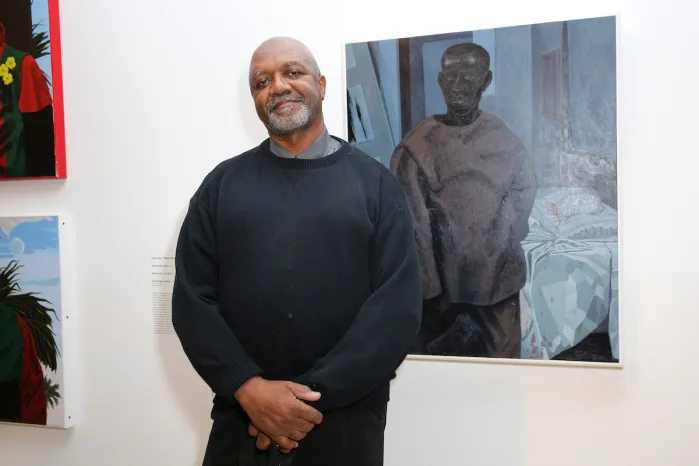
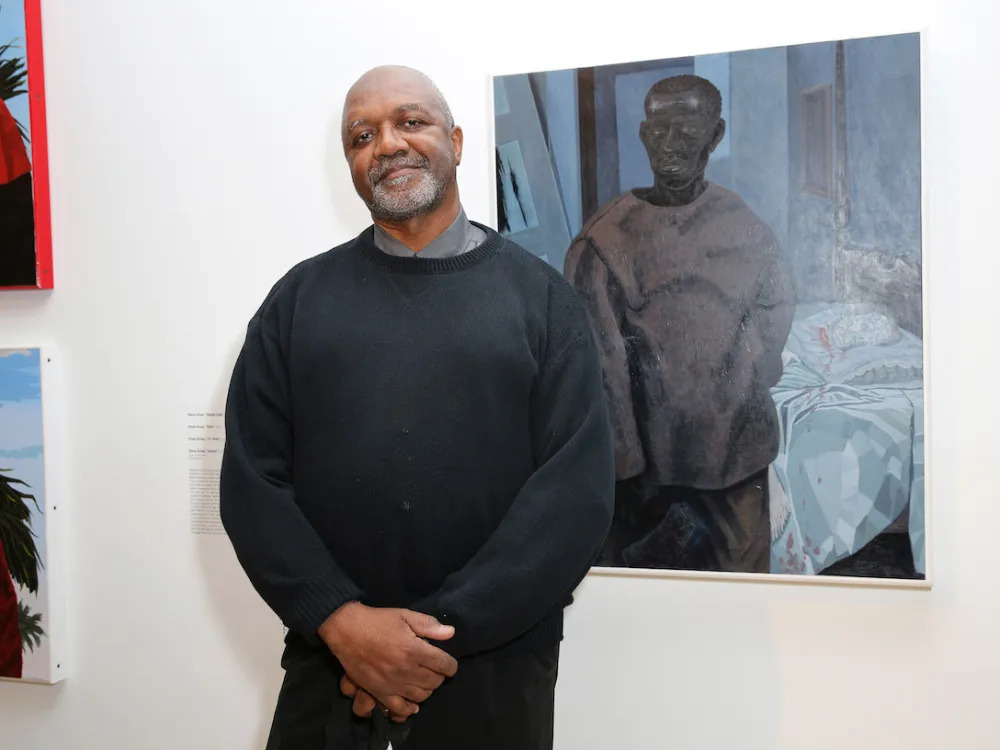
Superlatives have been lavished upon Kerry James Marshall, and understandably so. His acclaimed paintings of the past four and a half decades have challenged the systemic exclusion of Black figures across art history while also protesting racism in the present—no small task, and not an easy one. Perhaps it is appropriate, then, to label Marshall a genius or a master, just as you might for a portraitist of the Dutch Golden Age or an abstractionist of the 20th century.
But Marshall (b. 1955) has preferred a different term for himself: radical pragmatist, the label given to him by a friend, the artist Arthur Jafa. “I do see myself that way,” Marshall recently told the art historian Benjamin H. D. Buchloh. “As a strategy, as a technique, I try to know as much as possible about the operation, construction, and appearance of art so that I can be more precise in the way I deploy whatever seems most effective for the project.”
That statement is itself a form of radical pragmatism, a gentle way of sanding down the very notion of mastery that has long guided our understanding of male artists in the West. No surprise that his traveling U.S. survey, mounted by the Metropolitan Museum of Art in the mid 2010s, was given the intentionally misspelled subtitle “Mastry.”
Now Marshall has another survey, this one taking place (through January 18, 2026) at the Royal Academy of Arts in London. That show, titled “Kerry James Marshall: The Histories,” is loosely themed around the notion of history painting vis-à-vis this artist’s work. Considered the highest form of art-making during the bygone days of the Paris Salon, history painting has been given a fresh workup by Marshall, who uses the format’s conventions to speak to our present.
Marshall’s art has been a lodestar for a range of figurative painters in the past decade. ARTnews even placed a Marshall painting at #3 on a recent list of the 100 best artworks of this century so far. Yet one joy of Marshall’s art is that it does not announce itself as major, forcing viewers to reckon with the very notion of greatness. Below, we offer a guide to five key examples of Marshall’s radical pragmatism.
-
De Style, 1993

Image Credit: ©Museum Associates/Los Angeles County Museum of Art/Artwork ©Kerry James Marshall Often, Marshall’s Black figures are themselves painted in black rather than brown hues that might appear more naturalistic. Marshall’s gesture is straightforward: The skin tones that feature in this painting, for example, are made using three black pigments rather than one, a literal way of showing that blackness—and by extension Blackness—is more complex than many are willing to notice.
By 1993, Marshall had already been painting Black people in black shades for more than a decade. In 1980, he made a splash with A Portrait of the Artist as a Shadow of His Former Self, in which a Black man’s face recedes into the painting’s black background, with a toothy smile and a pair of white eyes emerging from the dark void. As Mark Godfrey, curator of the current Royal Academy show, points out in the exhibition’s catalog, that portrait can be viewed as an indirect reference to Ralph Ellison’s 1952 novel, Invisible Man, whose Black protagonist notes that people “refuse to see” him. In painting his own figures in this way, Marshall was asking: Who refuses to see people like me, and why?
De Style provides an answer of sorts. Its name refers to a modernist Dutch movement known as De Stijl, whose progenitors were all white and included painters such as Piet Mondrian. (Critic Jordan Kantor has convincingly argued that the checkerboard tiling of the barbershop in the latter picture is a reference to Mondrian’s pared-down squares of color.) Yet Marshall’s subjects here are all Black, and they appear in a setting that Mondrian likely would never have set foot in: a barbershop that appears—based on a style guide appearing in a mirror behind the figures, at least—to cater mainly to Black men. The mirror, which occupies nearly half of the painting, is itself an allusion to another white European: Édouard Manet, whose 1882 painting A Bar at the Folies-Bergère uses a similar device.
Whereas paintings by Manet and Mondrian were staples in American and European museums by the time Marshall painted De Style, canvases filled with Black figures were not. This painting could thus be read as a response to this systemic exclusion. The work became Marshall’s first-ever museum acquisition when the Los Angeles County Museum of Art bought it the year it was made.
-
Knowledge and Wonder, 1995
Image Credit: Patrick L. Pyszka, City of Chicago/©Kerry James Marshall/City of Chicago Public Art Program and the Chicago Public Library, Legler Regional Library De Style’s checkerboard tiling reappears in Knowledge and Wonder, but the latter is not quite a work about art history in the same way. Instead, it’s a work about how art can—and often does—help birth new realities for those who come before it.
In this 23-foot-long mural, a group of kids are shown constructing their world, with one toting a gigantic book covers and putting it in place. Meanwhile, a ladder toward the right suggests an opportunity for the children to ascend and achieve their full potential. A painter of the past—say, an exponent of the Renaissance or the Neoclassicist movement—would have made all these students white and wanted this painting to be seen in a museum. Instead, Marshall made the mural for the Legler Library in Chicago, the city where he has lived since 1987, and his figures are again all Black. At that library, the mural has lived up to its title, inspiring wonder.
In 2018, however, events surrounding the mural generated anger. That year, Chicago officials moved to sell the work at Christie’s at an estimated price of $10 million to $15 million. Marshall was among those who urged the city to reconsider, telling ARTnews that Chicago had “wrung every bit of value they could from the fruits of my labor.” Ultimately the city changed its mind and pulled the work from the sale. Since then, the mural has generally remained on view in the city, though it has voyaged abroad for the Marshall show at the Royal Academy.
-
Untitled, 2009
Image Credit: ©Kerry James Marshall/Yale University Art Gallery Think of a painting of an artist at work, and you might imagine something like René Magritte’s La clairvoyance (1936), in which a white male who looks a bit like the Surrealist himself stares at an egg and paints the bird that may eventually hatch from it. Magritte’s painter is so schooled in the ways of form that he can represent the animal without even seeing it in front of him—a winking satire of the artist as a highly skilled craftsman. Marshall ups Magritte’s ante, then goes in a different direction with this untitled work, in which a Black female artist sits before a painting. The twist: She works not from her mind but using the paint-by-numbers method, which is intended to be so easy that anybody can do it. If she went to art school, she clearly didn’t pay much attention.
But Marshall’s work can’t exactly be considered parody in the way Magritte’s can, for Marshall’s painting seems to have more to say. In replacing the traditional white male with a Black woman, Marshall is proposing that our ideas about art making need to change, and that the barriers for acceptance need to be let down. Sure, she works using an amateurish method. Perhaps she’s even a Sunday painter. Yet she’s a painter all the same and ought to be seen as such. In Artforum, the painter Carroll Dunham wrote that, standing before this work, “one thinks of the parallel tracks of history not (yet) realized where our ‘great artists’ are black women and their contribution is a precise and literal mapping of the self in pictorial terms.”
-
School of Beauty, School of Culture, 2012
Image Credit: Sean Pathasema/©Kerry James Marshall/Courtesy the artist and Jack Shainman Gallery/Birmingham Museum of Art This painting is a sequel of sorts to De Style, this time set in a hairdresser’s business with a focus on women instead of men. Symbols of Black culture are everywhere. The cover for an album by the beloved rapper Lauryn Hill hangs on a rear wall, and an awning in shades of red, green, and black—the colors of the Pan-African flag—is reflected in this salon’s mirrors. In the upper right-hand corner, there’s also a poster for a Tate show by Chris Ofili, the first Black artist to win the Turner Prize.
All these images and symbols collide with references to key works by white painters. Marshall himself can be seen in one mirror, photographing the scene—a reference to Diego Velázquez’s inclusion of himself via a reflective surface in Las Meninas (1656). Meanwhile, on the floor, there’s a tilted, warped image of Sleeping Beauty. That’s an allusion to Hans Holbein the Younger’s The Ambassadors (1533), which features an anamorphic skull.
There’s a mismatch between this white art history and Black contemporary culture, and between Sleeping Beauty and the Black women pictured here. The resulting tension alludes to the unfair standards stacked against Black communities across the globe. That few of these women seem to care, continuing to primp their hair and strut their stuff anyway, suggests survival in spite of it all. The late critic Greg Tate accordingly called this remarkable painting “a paean to black looking as a form of black self-loving.”
-
Untitled (policeman), 2015
Image Credit: ©Kerry James Marshall/Scala, Florence/Museum of Modern Art Marshall’s art has never lent itself to neat, easily legible statements. But what to make of a troubling painting like this one, especially in light of so many highly visible acts of police violence committed against Black men and women? Is it easier or harder to see this painting, produced one year after the shooting of Michael Brown in Ferguson, Missouri, because it depicts a Black cop? Does it even matter?
Further complicating this painting is the fact that Marshall has insisted it was not a response to Ferguson, or to any other recent police killing before it. Moreover, the painting is not based on a real policeman—Marshall used toys as his models for both the person and the car—and though this cop apparently works for the Chicago Police Department, given his badge and his vehicle, there are no obvious signifiers of the city itself. Untitled (policeman) is thus both embedded in our reality and slightly removed from it.
The key to unlocking this painting, as the art historian Darby English has proposed, is Marshall’s choice to place the viewer slightly below the officer. Tamir Rice or Aiyana Stanley-Jones “may have stood at around that height when their lives were ended,” English notes. But, he adds, the picture is not straightforward enough to rest only on that observation: “Marshall tells us not how to think. Rather, he asks us to hold the ideas ‘black’ and ‘policeman’ at the same time, and, further, to hold this possibly excruciating pose.”
De Style, 1993
Often, Marshall’s Black figures are themselves painted in black rather than brown hues that might appear more naturalistic. Marshall’s gesture is straightforward: The skin tones that feature in this painting, for example, are made using three black pigments rather than one, a literal way of showing that blackness—and by extension Blackness—is more complex than many are willing to notice.
By 1993, Marshall had already been painting Black people in black shades for more than a decade. In 1980, he made a splash with A Portrait of the Artist as a Shadow of His Former Self, in which a Black man’s face recedes into the painting’s black background, with a toothy smile and a pair of white eyes emerging from the dark void. As Mark Godfrey, curator of the current Royal Academy show, points out in the exhibition’s catalog, that portrait can be viewed as an indirect reference to Ralph Ellison’s 1952 novel, Invisible Man, whose Black protagonist notes that people “refuse to see” him. In painting his own figures in this way, Marshall was asking: Who refuses to see people like me, and why?
De Style provides an answer of sorts. Its name refers to a modernist Dutch movement known as De Stijl, whose progenitors were all white and included painters such as Piet Mondrian. (Critic Jordan Kantor has convincingly argued that the checkerboard tiling of the barbershop in the latter picture is a reference to Mondrian’s pared-down squares of color.) Yet Marshall’s subjects here are all Black, and they appear in a setting that Mondrian likely would never have set foot in: a barbershop that appears—based on a style guide appearing in a mirror behind the figures, at least—to cater mainly to Black men. The mirror, which occupies nearly half of the painting, is itself an allusion to another white European: Édouard Manet, whose 1882 painting A Bar at the Folies-Bergère uses a similar device.
Whereas paintings by Manet and Mondrian were staples in American and European museums by the time Marshall painted De Style, canvases filled with Black figures were not. This painting could thus be read as a response to this systemic exclusion. The work became Marshall’s first-ever museum acquisition when the Los Angeles County Museum of Art bought it the year it was made.
Knowledge and Wonder, 1995
De Style’s checkerboard tiling reappears in Knowledge and Wonder, but the latter is not quite a work about art history in the same way. Instead, it’s a work about how art can—and often does—help birth new realities for those who come before it.
In this 23-foot-long mural, a group of kids are shown constructing their world, with one toting a gigantic book covers and putting it in place. Meanwhile, a ladder toward the right suggests an opportunity for the children to ascend and achieve their full potential. A painter of the past—say, an exponent of the Renaissance or the Neoclassicist movement—would have made all these students white and wanted this painting to be seen in a museum. Instead, Marshall made the mural for the Legler Library in Chicago, the city where he has lived since 1987, and his figures are again all Black. At that library, the mural has lived up to its title, inspiring wonder.
In 2018, however, events surrounding the mural generated anger. That year, Chicago officials moved to sell the work at Christie’s at an estimated price of $10 million to $15 million. Marshall was among those who urged the city to reconsider, telling ARTnews that Chicago had “wrung every bit of value they could from the fruits of my labor.” Ultimately the city changed its mind and pulled the work from the sale. Since then, the mural has generally remained on view in the city, though it has voyaged abroad for the Marshall show at the Royal Academy.
Untitled, 2009
Think of a painting of an artist at work, and you might imagine something like René Magritte’s La clairvoyance (1936), in which a white male who looks a bit like the Surrealist himself stares at an egg and paints the bird that may eventually hatch from it. Magritte’s painter is so schooled in the ways of form that he can represent the animal without even seeing it in front of him—a winking satire of the artist as a highly skilled craftsman. Marshall ups Magritte’s ante, then goes in a different direction with this untitled work, in which a Black female artist sits before a painting. The twist: She works not from her mind but using the paint-by-numbers method, which is intended to be so easy that anybody can do it. If she went to art school, she clearly didn’t pay much attention.
But Marshall’s work can’t exactly be considered parody in the way Magritte’s can, for Marshall’s painting seems to have more to say. In replacing the traditional white male with a Black woman, Marshall is proposing that our ideas about art making need to change, and that the barriers for acceptance need to be let down. Sure, she works using an amateurish method. Perhaps she’s even a Sunday painter. Yet she’s a painter all the same and ought to be seen as such. In Artforum, the painter Carroll Dunham wrote that, standing before this work, “one thinks of the parallel tracks of history not (yet) realized where our ‘great artists’ are black women and their contribution is a precise and literal mapping of the self in pictorial terms.”
School of Beauty, School of Culture, 2012
This painting is a sequel of sorts to De Style, this time set in a hairdresser’s business with a focus on women instead of men. Symbols of Black culture are everywhere. The cover for an album by the beloved rapper Lauryn Hill hangs on a rear wall, and an awning in shades of red, green, and black—the colors of the Pan-African flag—is reflected in this salon’s mirrors. In the upper right-hand corner, there’s also a poster for a Tate show by Chris Ofili, the first Black artist to win the Turner Prize.
All these images and symbols collide with references to key works by white painters. Marshall himself can be seen in one mirror, photographing the scene—a reference to Diego Velázquez’s inclusion of himself via a reflective surface in Las Meninas (1656). Meanwhile, on the floor, there’s a tilted, warped image of Sleeping Beauty. That’s an allusion to Hans Holbein the Younger’s The Ambassadors (1533), which features an anamorphic skull.
There’s a mismatch between this white art history and Black contemporary culture, and between Sleeping Beauty and the Black women pictured here. The resulting tension alludes to the unfair standards stacked against Black communities across the globe. That few of these women seem to care, continuing to primp their hair and strut their stuff anyway, suggests survival in spite of it all. The late critic Greg Tate accordingly called this remarkable painting “a paean to black looking as a form of black self-loving.”
Untitled (policeman), 2015
Marshall’s art has never lent itself to neat, easily legible statements. But what to make of a troubling painting like this one, especially in light of so many highly visible acts of police violence committed against Black men and women? Is it easier or harder to see this painting, produced one year after the shooting of Michael Brown in Ferguson, Missouri, because it depicts a Black cop? Does it even matter?
Further complicating this painting is the fact that Marshall has insisted it was not a response to Ferguson, or to any other recent police killing before it. Moreover, the painting is not based on a real policeman—Marshall used toys as his models for both the person and the car—and though this cop apparently works for the Chicago Police Department, given his badge and his vehicle, there are no obvious signifiers of the city itself. Untitled (policeman) is thus both embedded in our reality and slightly removed from it.
The key to unlocking this painting, as the art historian Darby English has proposed, is Marshall’s choice to place the viewer slightly below the officer. Tamir Rice or Aiyana Stanley-Jones “may have stood at around that height when their lives were ended,” English notes. But, he adds, the picture is not straightforward enough to rest only on that observation: “Marshall tells us not how to think. Rather, he asks us to hold the ideas ‘black’ and ‘policeman’ at the same time, and, further, to hold this possibly excruciating pose.”
This N.Y.C. Steakhouse Just Unveiled 22-Seat Korean Tasting Counter Hidden Inside
Inside the Victoria’s Secret Fashion Show
Blue Jays Remain Canada’s Team Though Expos Still on the Mind